
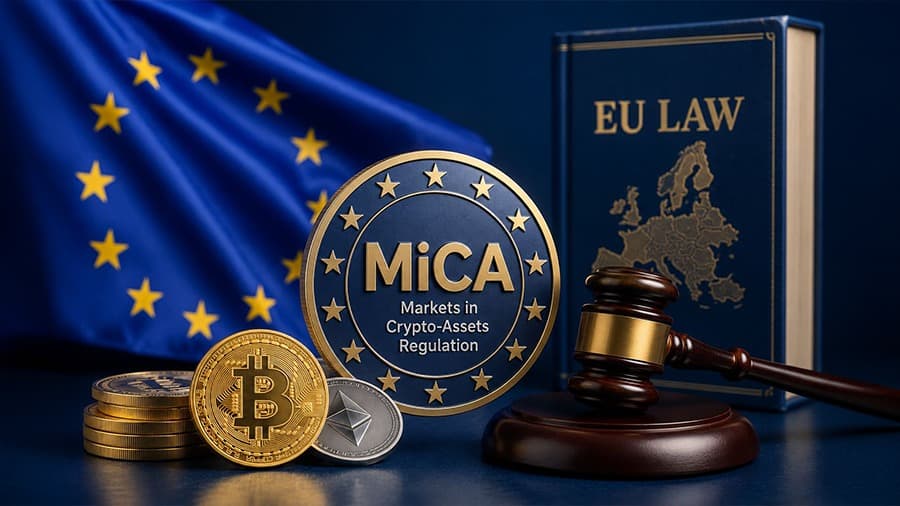
MiCA Explained: What the New EU Crypto Regulation Means for Digital Financial Platforms and Crypto Users
Reading time: Approximately 5 minutes
Since July 2026, the Markets in Crypto-Assets Regulation (MiCA) has been fully applicable across the European Union. But what does this actually mean for people who use cryptocurrencies or engage with digital financial services? Will cryptocurrencies be banned? Are private wallets affected? Or does MiCA genuinely provide greater security and transparency?
Numerous misconceptions continue to circulate regarding the new EU regulation. In reality, MiCA has a clear objective: for the first time, it establishes a harmonized legal framework for the European crypto market—without restricting cryptocurrencies as such. For consumers, this means greater clarity and protection; for businesses, clearly defined rules; and for the market as a whole, an important step toward greater maturity and professionalism.
What is MiCA?
MiCA stands for the Markets in Crypto-Assets Regulation and represents the European Union's first comprehensive regulatory framework for crypto-assets.
Unlike an EU Directive, which must first be implemented into national law, an EU Regulation applies directly in every Member State. As a result, MiCA replaces the previous patchwork of differing national regulations with a single, harmonized legal framework across the European Union.
The transitional period for existing crypto service providers expired across the EU on 1 July 2026. Consequently, the new regulatory requirements are now fully applicable.
MiCA in 30 Seconds
EU-wide regulation for the crypto market
Harmonized rules across all 27 EU Member States
Applies to crypto service providers, trading platforms, and stablecoin issuers
Greater transparency and stronger consumer protection
Higher standards for security, governance, and compliance
A unified European market for digital financial services
Why Was MiCA Introduced?
The crypto market has experienced rapid growth in recent years. At the same time, regulatory requirements across Europe evolved very differently.
While some countries had already introduced comprehensive regulatory frameworks, others had little or no binding legislation in place. This created significant challenges for companies operating across borders and made it difficult for consumers to assess which providers were trustworthy and what risks they were taking.
The collapse of the Terra/LUNA ecosystem in 2022 highlighted the urgent need for a consistent regulatory framework governing crypto-assets throughout Europe.
With MiCA, the European Union aims to address these challenges by pursuing several key objectives.
Objectives of the MiCA Regulation
Strengthen consumer protection
Increase transparency and disclosure requirements
Establish a level playing field across the European market
Foster innovation rather than hinder it
Create a unified European market for crypto-assets
Who Does MiCA Apply To?
MiCA is primarily aimed at businesses that provide crypto-related services on a commercial basis.
These include, among others:
Cryptocurrency exchanges
Digital asset trading platforms
Wallet and custody service providers
Issuers of digital assets
Stablecoin issuers
Crypto financial service providers
Private individuals who simply buy and hold cryptocurrencies for their own account are not subject to MiCA.
Anyone who stores Bitcoin, Ethereum, or other digital assets in a self-custody wallet, where they retain full control over their private keys, does not require a MiCA licence.
What Does MiCA Mean for Consumers?
For consumers, MiCA delivers one key benefit above all else: greater transparency.
Going forward, crypto service providers will be required to disclose more comprehensive information and comply with stricter organisational and operational standards. This gives consumers a stronger foundation for comparing services, assessing providers, and understanding potential risks.
Key Benefits at a Glance
Clearer information about products and services
Higher security standards for service providers
Transparent organisational and operational requirements
Harmonised regulations across the European Union
Greater confidence through consistent minimum standards
However, it is important to understand that MiCA does not protect consumers against market volatility or poor investment decisions. The regulation governs the conduct of service providers—not the price performance of cryptocurrencies.
Important to Know
Not every platform operating in Europe—or claiming to have a European corporate presence—automatically complies with all MiCA requirements.
An ongoing licensing application should not be confused with an approved MiCA authorisation. Users should therefore verify whether their specific service provider is listed as an authorised Crypto-Asset Service Provider (CASP) in the official ESMA register.
Because a provider's regulatory status may change over time, it is advisable to review this information periodically.
What Does MiCA Mean for Businesses?
MiCA significantly raises the regulatory bar for crypto businesses.
Compliance, risk management, IT security, and transparent governance will play an increasingly central role. Companies must demonstrate that they meet the required organisational, technical, and financial standards to operate in accordance with the new regulatory framework.
At the same time, MiCA creates substantial opportunities.
Once authorised, providers can offer their services more easily across Europe without having to comply with 27 different national regulatory regimes.
This so-called passporting mechanism enables authorised providers to operate throughout the European Economic Area (EEA) under a single regulatory framework. As a result, regulatory barriers are reduced, making cross-border business models significantly more efficient.
For many companies, this marks an important step towards a truly integrated European market for digital financial services.
Three Common Misconceptions About MiCA
"MiCA bans cryptocurrencies."
False.
MiCA neither prohibits the ownership nor the private purchase of cryptocurrencies. Instead, it establishes a regulatory framework for businesses that provide crypto-related services.
"Private wallets will be banned."
This is also incorrect.
Self-custody wallets, where users retain full control over their private keys, remain fully permitted under MiCA.
"MiCA will eliminate crypto fraud."
Unfortunately, that's not the case either.
MiCA strengthens regulatory oversight and imposes higher standards on crypto service providers. However, consumers should still carefully evaluate the companies they choose to do business with and remain vigilant against fraudulent schemes.
What Does MiCA Mean for Modern Financial Platforms?
Although MiCA is primarily aimed at businesses, consumers ultimately benefit from a clearer and more transparent regulatory environment. Transparent processes, accessible information, and high security standards will increasingly determine which financial service providers earn the trust of both individuals and businesses.
International digital financial platforms are closely monitoring these developments. Regardless of whether specific services are provided within or outside the European Union, compliance, anti-money laundering (AML), Know Your Customer (KYC) procedures, and transparent corporate governance are becoming increasingly important worldwide.
International regulatory standards are rapidly evolving into a competitive advantage—not only from a compliance perspective but also as a key driver of customer confidence. In an industry where trust is becoming the most valuable currency, transparent processes and accountable corporate structures are essential foundations for long-term success.
"MiCA is not transforming the crypto market through prohibitions—it is transforming it through clear rules. That transparency will become one of the defining trust factors for digital financial services in the years ahead."
Dirk Delitz, CEO, Smart Energy Pay
One example is Smart Energy Pays. The digital financial platform combines multiple financial services—including virtual accounts, offshore accounts, cryptocurrency wallets, stablecoins, and international payment solutions—within a single integrated ecosystem.
At the same time, the platform is committed to transparent processes, comprehensive KYC and AML procedures, and publicly available information regarding privacy, compliance, and its legal framework. This demonstrates that regulatory compliance and digital innovation are not mutually exclusive, but can work together to build lasting trust and support the sustainable development of digital financial services.
Conclusion
MiCA is not a ban on cryptocurrencies, nor does it eliminate all risks associated with digital assets. Instead, it establishes the first harmonised legal framework for large parts of the European crypto sector, strengthening transparency, consumer protection, and legal certainty across the European Union.
For consumers, this means greater clarity and confidence when choosing crypto service providers. For businesses, MiCA introduces higher regulatory requirements while also creating the opportunity to offer digital financial services throughout Europe under a single regulatory framework.
Over the long term, MiCA is expected to strengthen trust in digital financial services and accelerate the integration of digital assets into everyday finance. Consumers benefit from greater transparency, businesses gain a more predictable regulatory environment, and the European crypto market is better positioned to develop into a secure, innovative, and globally competitive ecosystem.
MiCA Explained: Five Frequently Asked Questions
When does MiCA apply?
MiCA has been introduced in phases since the end of 2024. The transitional period for existing crypto service providers across the European Union ended on 1 July 2026, making the regulation fully applicable.
Does MiCA apply to Bitcoin?
Yes—but not to Bitcoin itself.
MiCA regulates businesses that commercially provide services involving Bitcoin and other crypto-assets, such as custody, trading, brokerage, or other crypto-related financial services.
Are private wallets affected?
No.
Individuals who store their cryptocurrencies in a self-custody wallet remain outside the scope of MiCA and do not require any regulatory authorisation.
Who is responsible for enforcing MiCA?
Within each EU Member State, the relevant national financial supervisory authorities are responsible for authorisation and ongoing supervision.
At the European level, regulatory coordination is carried out primarily by the European Securities and Markets Authority (ESMA) and the European Banking Authority (EBA).
Does MiCA make cryptocurrencies safe?
MiCA improves transparency and establishes minimum regulatory standards for crypto service providers.
However, market volatility, price fluctuations, and investment risks remain an inherent part of investing in crypto-assets.
Disclaimer
This article is provided for general informational purposes only and does not constitute legal, financial, or investment advice. Regulatory requirements may continue to evolve over time. For authoritative guidance, readers should consult the publications of the relevant supervisory authorities and, where appropriate, seek independent legal or professional advice.